Live Cantonese Translation at Events: Why Most Tools Fail and How to Get It Right
 Collins Tam10 min readPastor of CCiL and co-founder of Event Translate
The MC on stage says: “個 keynote speaker 臨時放飛機,我哋要即刻搵人 cover。”
Any Hong Kong listener knows what she means: the keynote speaker has pulled out at the last minute, and they need someone to cover, fast.
The English captions say something else: “The keynote speaker temporarily released an aeroplane, we must immediately find people to cover.”
No aircraft was involved. 放飛機, literally “to release a plane”, is Hong Kong slang for letting someone down at the last minute. Translate it word by word and you get exactly that caption, which is roughly what Cantonese speakers at international events have learned to expect from machine translation: every word accounted for, the meaning wandered off somewhere near the fire exit.
This guide explains why Cantonese trips up so many tools, what to ask before you trust one with your event, and how to set up a Cantonese session people can actually follow.
The short answer: most speech and translation systems learn far more Mandarin and standard written Chinese than spoken Cantonese, so they misread colloquial words, stumble on fast tonal speech and drop the English phrases Cantonese speakers mix into their sentences. To get it right, choose a tool tested on spoken Cantonese that handles mixed Cantonese–English, feed it a clean microphone signal, load a glossary of names and terms, and rehearse with a fluent Cantonese speaker before the day.
Why Cantonese is hard for machines
Cantonese is not Mandarin with an accent. It has about 80 million speakers across Guangdong, Guangxi, Hong Kong, Macau and a worldwide diaspora, and Cantonese and Mandarin speakers understand each other’s speech very little. For a machine, six things make it harder than those numbers suggest.
| Challenge | What it looks like | What goes wrong |
|---|---|---|
| People write one way and speak another | Formal writing (news, subtitles, government) uses standard written Chinese, which is close to Mandarin. Speech is full of words like 佢 (he or she), 嘅 (’s), 唔 (not) and 咗 (done) | A model that learned from written Chinese meets words it has rarely seen, then guesses or “corrects” them into Mandarin-style text |
| Six tones | Cantonese has six tones, two more than Mandarin | Words that differ only in tone get swapped, especially in fast speech |
| Idioms and slang | 放飛機 (“release a plane”, meaning to let someone down at the last minute), 一頭霧水 (“a head of fog”, meaning confused) | Literal translation: every word right, the meaning wrong |
| English mixed in | 等陣 workshop 之後,我哋會有 networking time | Single-language tools drop or garble the English (more below) |
| Less training data | Researchers building Cantonese speech corpora still describe a shortage of data | Less exposure means lower accuracy, especially on casual speech |
| Two scripts, many spellings of names | Traditional characters in Hong Kong, Simplified on the mainland; names romanised Hong Kong-style (Chan, Wong, Cheung) | The wrong script for the audience, and speakers’ names mangled |
That is why a tool’s general “Chinese” accuracy tells you very little about how it will cope with a Cantonese keynote, a Sunday sermon or a Q&A in Kowloon.
Code-switching: when one sentence speaks two languages
In Hong Kong, and in Hong Kong churches, businesses and families abroad, it is completely normal to drop English into Cantonese: meeting, deadline, project, workshop, networking. Linguists call it code-switching. Listeners barely notice it; most translation software can’t get past it.
The reason is simple. Most live translation tools ask you to pick one source language. Set it to Cantonese and the English words become noise; set it to English and the Cantonese vanishes.
| The speaker says | A single-language tool gives | A mixed-language tool gives |
|---|---|---|
| 等陣 workshop 之後,我哋會有 networking time。 | …workshop… networking time… | After the workshop, we will have networking time. |
Event Translate’s Multi-language mode detects more than 70 spoken languages automatically and follows a speaker who switches mid-sentence, including Cantonese and English. Nobody has to touch a setting when the chair switches to English to welcome a guest and back to Cantonese for the notices. The same matters in Malaysia and Singapore, where Cantonese is widely spoken alongside English and other languages.
What the numbers show, and how to read them
On our homepage we publish one Cantonese test case: 佢啱啱講嗰part有啲離地,大家聽到一頭霧水 (“the part he just covered was out of touch, and everyone was confused”). A standard model scored 58% accuracy on it, turning the confusion into “a head of fog”; Event Translate scored 94.9%. It is a single sentence, so read it as an illustration rather than a benchmark.
That is a striking gap, but treat any single figure, including ours, with healthy suspicion. Four things to check when a vendor quotes Cantonese accuracy:
- One sentence is not a benchmark. Ask for results across a set of real clips with different speakers.
- Check the metric. Chinese is written without spaces between words, so accuracy is normally measured by character error rate rather than the word error rate used for English. Figures from English benchmarks don’t carry over.
- Read speech flatters everyone. Several public Cantonese datasets are recordings of people reading aloud (one widely used corpus comes from audiobooks). A pastor or keynote speaker talking freely is much harder.
- Test your own speakers. The only result that really counts is your speaker, in your room, through your microphones.
Seven questions to ask any tool before a Cantonese event
Put these to every vendor on your shortlist, us included, and ask to see the answer working rather than read it on a slide.
- Was it tested on spoken Cantonese, or on written Chinese read aloud? Play it a clip of someone talking casually and watch the captions.
- Does it handle Cantonese and English in the same sentence without anyone switching settings?
- Which script do the captions use? Hong Kong and diaspora audiences expect Traditional characters; mainland guests may prefer Simplified.
- When English is translated into Cantonese, is the voice actually speaking Cantonese, or reading Chinese text in Mandarin?
- Can you add names to a glossary in both forms, such as 陳大文 and Chan Tai Man, plus place names and organisation names?
- Where is the audio processed, and is it used for training? With Event Translate, Cantonese and Mandarin speech recognition can run entirely on hardware we own, no recordings are kept, and every AI provider we use is contractually barred from training on your content.
- How is it priced? Per listener, per event or per minute? With Event Translate listeners are never charged, so a Cantonese channel for 20 elders costs the same as one for 200.
How to set up live Cantonese translation, step by step
1. Decide which way the translation runs
Cantonese speakers on stage with international guests in the audience need Cantonese into English (and perhaps Mandarin). An English keynote with Cantonese-speaking elders in the room needs English into Cantonese. Many events need both. If speakers will switch languages, set the source to Multi-language, then choose the output languages your audience asked for.
2. Give it a clean feed
Fast, tonal speech needs a clean signal, because a tone lost in the room is a word lost in the translation. Take a dedicated feed from the mixer that carries the speakers’ microphones and leaves out music and room noise, and connect it to the laptop through a USB audio interface. Our audio and mixer guide explains the options.
3. Build a bilingual glossary
Add every speaker’s name in Chinese characters and in their own romanisation, your organisation and sponsor names, place names (尖沙咀, Tsim Sha Tsui) and the jargon of your field. Set the preferred English and Cantonese rendering for each. The glossary locks once translation starts, so finish it during setup.
4. Brief your speakers
Tell them mixing Cantonese and English is fine; there is no need to perform “proper” Cantonese for the machine. Ask panellists not to talk over each other, and to explain a pun if the point depends on it, because tonal wordplay rarely survives any translation, human or machine.
5. Rehearse with a real speaker, not a script
Ask a fluent Cantonese speaker to tell a story at normal speed, with the slang and English they would really use, while a non-Cantonese colleague listens on their phone. Then reverse it. Five minutes of this tells you more than an hour of reading slides aloud.
6. Tell the audience how to join, in both languages
Put the QR code on the opening slide with instructions in English and Cantonese: “Scan the QR code, choose your language, use one earphone” and “掃 QR code,揀語言,戴一邊耳筒就得。” Keep spare earphones at registration.
Who needs this
- Hong Kong communities in the UK. By 30 June 2026 the Home Office had granted 187,552 visas under the Hong Kong British National (Overseas) route. In our experience many have joined or started churches and community groups where older members prefer Cantonese and younger ones English.
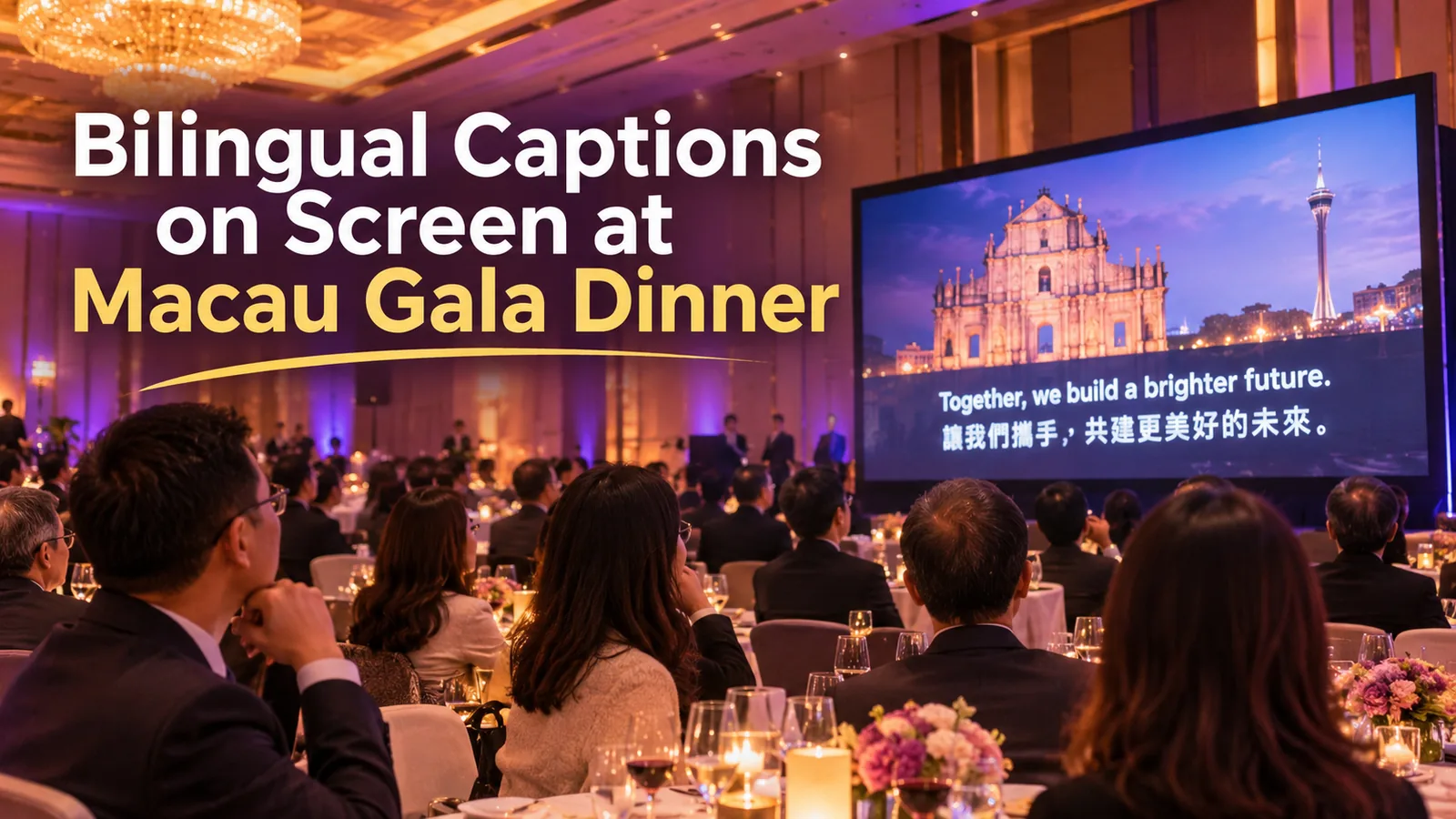
- Conferences and business events in Hong Kong and Macau, where international speakers meet local audiences, and local speakers meet international ones.
- Cantonese-speaking communities worldwide, from Malaysia and Singapore to Canada, the US and Australia.
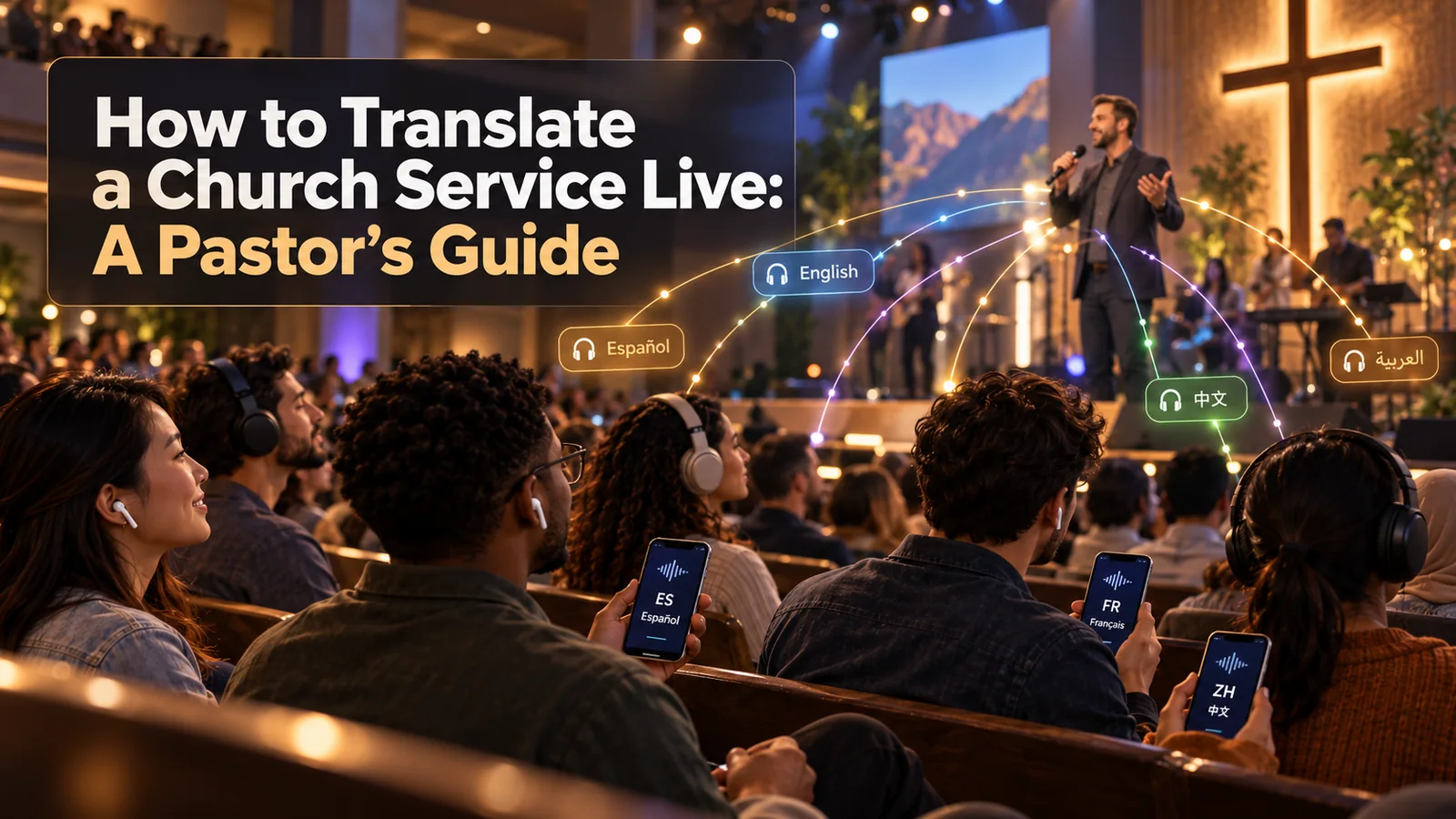
- Churches and mission events with Cantonese, Mandarin and English speakers in one room. Our church translation guide covers those in depth.
From the field
In July 2026 we ran live translation on board Logos Hope, OM’s missionary ship, for NEXT 2026: more than 200 people, with the programme in Cantonese, Mandarin and English. During a panel interview the host and guests kept talking over each other, yet Multi-mic mode kept each voice distinct and the translation stayed accurate. The full story is in our church translation guide.
The organisers of a trilingual church short-term mission event in the UK had been let down before. As Ricky from their audio-visual team told us: “We’ve tried several translation products before, but none of them worked well, especially for Cantonese. Your product was clearly better when we used it last time.”
Where AI still struggles
Be honest with your audience, and with yourself, about the limits:
- Noise and crosstalk. Several people talking at once, or a speaker away from the microphone, will hurt accuracy in any language.
- Wordplay. Cantonese humour loves tonal puns. Most will not survive translation, by machine or by human.
- Singing. Songs are not translated; show lyrics on screen in both languages.
- High-stakes conversations. For legal, medical or safeguarding matters, use a qualified human interpreter. Our comparison of AI and human interpreters explains when.
Bring the meaning in to land
Cantonese speakers have spent years being politely misunderstood by technology. They deserve captions that mean what the speaker meant.
The quickest way to judge is to try it with the speaker you are most worried about. Start a free 20-minute trial, no card needed, play a few minutes of real Cantonese through your own microphone, and read the result on your phone. Planning something bigger? Book a demo below and we will help you plan the audio and glossary.
Frequently asked questions
Is Cantonese the same as Mandarin?
No. They share much of the formal written language, but spoken Cantonese has different sounds, six tones instead of four, and a large everyday vocabulary of its own. Speakers of one usually can’t follow the other by ear.
Can AI translate Cantonese into English in real time?
Yes. With a clean audio feed, Event Translate delivers English audio and live captions to each listener’s phone moments after each phrase, typically starting around half a second after a natural pause.
Can English speeches be translated into spoken Cantonese?
Yes. Listeners choose Cantonese on their phone and hear a natural AI voice while reading live captions.
What if the speaker mixes Cantonese and English?
Set the source language to Multi-language. Event Translate detects more than 70 spoken languages automatically and follows switches mid-sentence.
How accurate is live Cantonese translation?
It depends most on the audio and the speaker. On the colloquial test sentence on our homepage, Event Translate scored 94.9% against 58% for a standard model. Rehearse with your own speakers before you rely on any figure.
Is our audio private?
Cantonese and Mandarin speech recognition can run entirely on hardware Event Translate owns. No recordings are kept, and every AI provider we use is contractually barred from training on your content.
Do listeners need an app?
No. They scan a QR code, choose a language and listen or read in their phone’s browser. No app or account is needed.