AI Interpretation vs Human Interpreters: Which Should You Use for Your Conference?
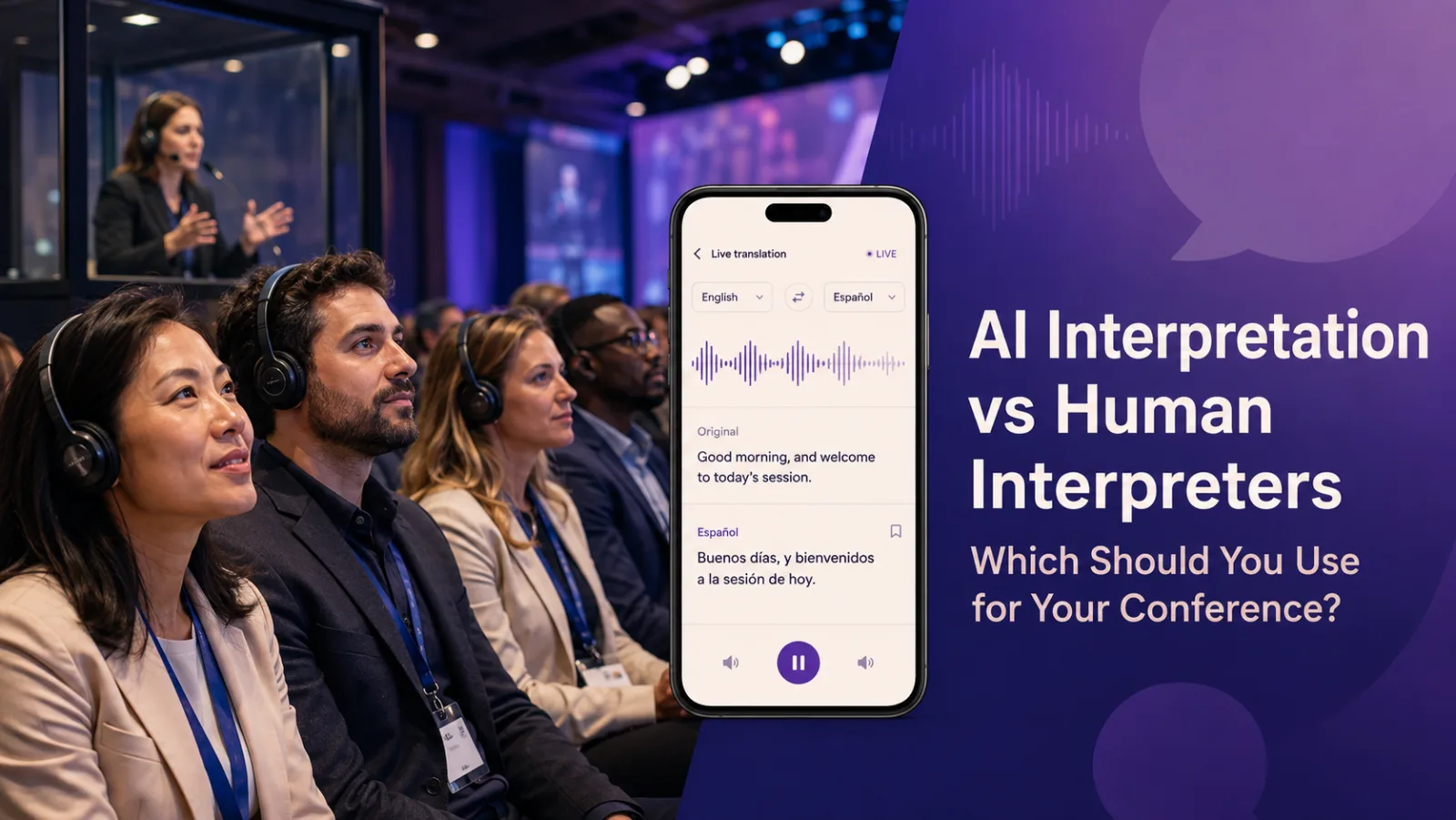
If you are planning a multilingual conference, you may be asking a question that was much simpler a few years ago: should we hire professional interpreters, use AI interpretation, or combine the two?
The honest answer is that neither option is automatically better. Human interpreters remain the stronger choice when a message is sensitive, highly nuanced or costly to misunderstand. AI interpretation can be a practical choice when organisers need to support more languages, serve a large audience, simplify logistics or make multilingual access possible within a limited budget.
The best decision depends less on whether the technology sounds impressive and more on two questions:
- How complex is the communication?
- What would happen if part of it were misunderstood?
This guide compares AI and human conference interpretation in practical terms so you can choose the right approach for your event.
First, what is the difference between translation and interpretation?
Translation usually refers to written content, while interpretation refers to spoken or signed communication. A conference interpreter listens to a speaker and conveys the meaning in another language, either after the speaker pauses (consecutive interpreting) or while the speaker continues (simultaneous interpreting).
In everyday searches, however, people often use phrases such as “live conference translation” or “real-time event translation.” That is why you will see both terms used in this article. Technically, live spoken-language support is interpretation, even when an AI platform is marketed as a translation tool.
How does human conference interpretation work?
A professional conference interpreter does more than replace words. They listen for meaning, follow the argument, make rapid judgements and express the message naturally for the target audience. They may adapt idioms, humour, tone and culturally specific references while preserving the speaker’s intention.
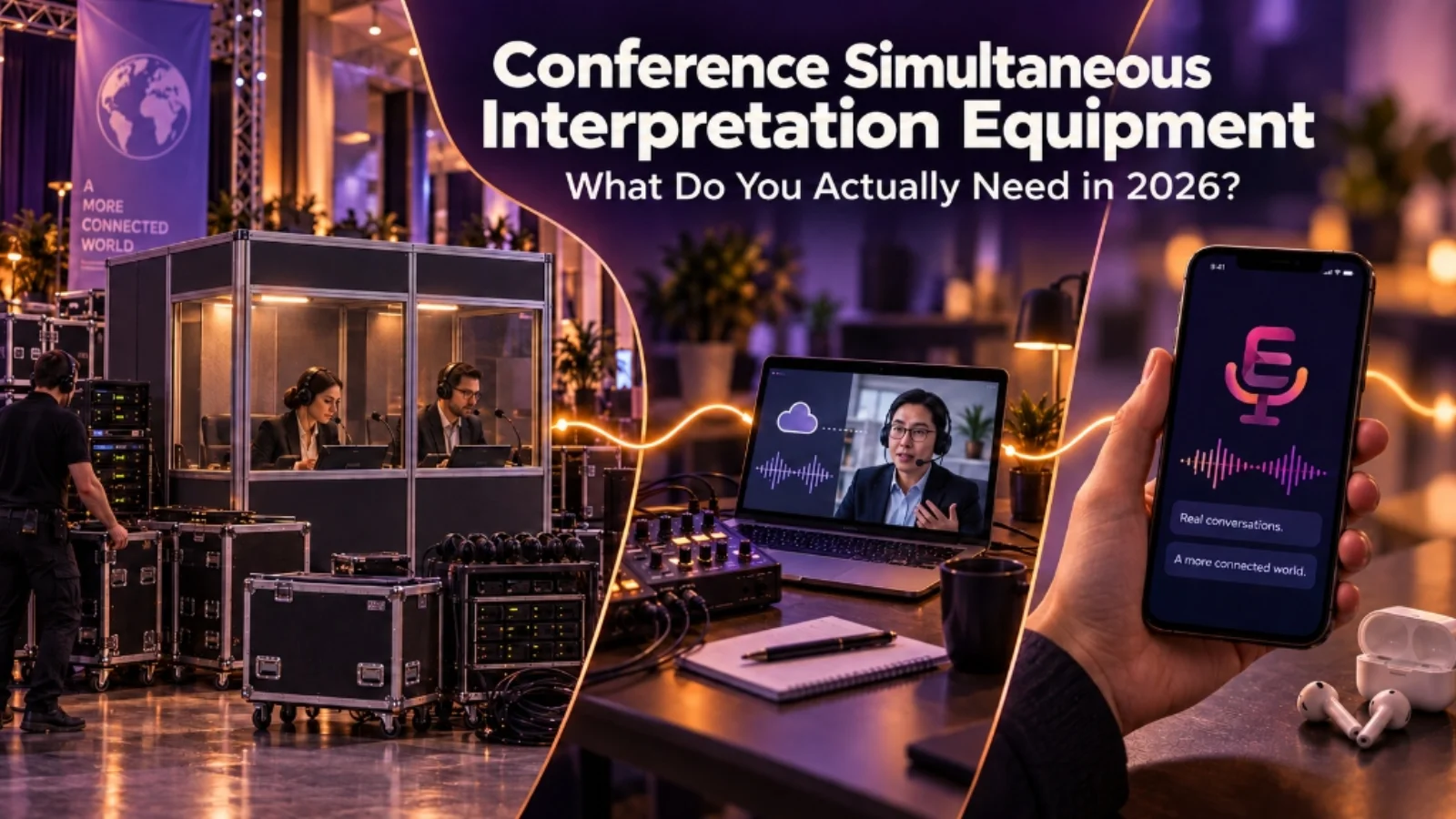
For simultaneous interpretation, interpreters commonly work with microphones, headsets and sound-isolated booths or through a remote interpreting platform. Longer sessions often require teams because simultaneous interpreting demands intense concentration. The international standard ISO 23155:2022 sets out requirements and recommendations for conference interpreting services, while the International Association of Conference Interpreters explains the main interpreting modes and professional setup.
This professional preparation and judgement are especially valuable when accuracy is not only helpful, but essential.
How does AI interpretation work?
AI interpretation typically follows several stages: it recognises the speaker’s voice, converts the speech into text, translates the meaning into one or more target languages, and then delivers translated captions, audio, or both.
Because the process is software-based, one event can potentially offer several languages without finding and scheduling a separate interpreter team for every language pair. Attendees may be able to join through their own phones rather than collecting dedicated receivers.
The quality still depends on the system, the languages involved and the conditions at the venue. A clear microphone feed, stable internet, well-structured speech and a prepared glossary can make a noticeable difference. Heavy room echo, music over speech, unclear pronunciation, overlapping speakers and unexplained specialist terms can all make the task harder.
AI interpretation vs human interpreters: the main differences
| Factor | AI interpretation | Human interpreters |
|---|---|---|
| Context and nuance | Can handle clear, structured speech well, but may miss implied meaning, humour, cultural references or emotional subtext. | Can interpret intention, tone, cultural context and ambiguity, and make informed judgement calls. |
| Accuracy and risk | Quality varies by language, audio conditions, terminology and platform. Best used where occasional errors can be tolerated and managed. | Usually the safer option for high-stakes communication, especially when interpreters have relevant subject expertise and preparation materials. |
| Number of languages | Can make several output languages available from one source feed, depending on the platform. | Each language combination requires suitable professionals, which can increase scheduling and coordination needs. |
| Cost structure | Often more economical at scale, particularly with many attendees or target languages. Pricing models vary by provider. | Includes professional time and may also involve travel, preparation, booths, receivers, technicians or remote-platform costs. |
| Setup and equipment | Often uses a laptop, an audio feed, internet access and attendees’ own devices. It is technically simpler in some venues, but it still needs testing. | May require interpreter booths, consoles, receivers and a technical team, or a remote interpreting setup with suitable audio. |
| Availability and lead time | Can be deployed quickly if the language is supported and the technical setup is ready. | Specialist interpreters and less common language pairs may need to be booked well in advance. |
| Audience scale | Software can serve a large audience without recruiting more interpreters for every additional listener. Capacity and pricing rules differ between platforms. | The interpreting team does not usually grow with every listener, but receiver distribution and venue equipment may become more complex. |
| Unexpected moments | May struggle when speakers talk over one another, abandon their prepared remarks or use unexplained names, acronyms and jokes. | Can recover, clarify, adapt phrasing and use knowledge of the session to manage unexpected changes. |
| Technical dependence | Relies on suitable audio, devices, software and usually a stable internet connection. | Also depends on good audio, but on-site teams may have more ways to notice and manage communication problems in real time. |
| Human interaction | Delivers language access, but it cannot read the room or take responsibility for a sensitive communication decision. | A professional can respond to emotion, audience reaction and ethical considerations, and can raise a concern when clarification is needed. |
When is AI interpretation a good choice for a conference?
AI interpretation is most useful when the communication is relatively structured and the consequences of an occasional imperfect phrase are limited.
It may be a good fit for:
- Keynotes, product presentations and internal updates with clear, prepared content
- Training sessions, workshops, lectures and community events
- Conferences that want to add more languages than the budget would otherwise allow
- Large audiences where per-listener equipment or fees would be difficult to manage
- Recurring or multi-day events that need a repeatable setup
- Events that want both translated audio and live captions
- A language added late, when a suitable interpreter team is not available
- Lower-risk breakout sessions within a larger conference
AI can also improve inclusion in a practical way. Without it, some organisers may offer only one interpreted language—or no language support at all. A carefully tested AI option may allow more attendees to follow the event in a language they understand.
However, “easy to start” should not mean “no preparation required.” Test the actual microphones, speaker styles, venue internet and target languages before the event. Add names, acronyms, product terms and specialist vocabulary to the system’s glossary when that feature is available. Give speakers simple guidance: use a microphone, speak clearly, avoid talking over one another and briefly explain uncommon abbreviations.
When should you choose human interpreters?
A professional human interpreter is the stronger choice when misunderstanding could materially affect someone’s rights, safety, health, finances or reputation.
Consider human interpreters for:
- Legal, medical, regulatory or safety-critical sessions
- Diplomatic meetings, negotiations and confidential executive discussions
- Sensitive HR conversations or crisis communication
- Speeches built around humour, wordplay, storytelling or culturally specific references
- Fast, unscripted debates with frequent interruptions
- Sessions in which the interpreter may need to request clarification or mediate meaning
- High-profile announcements where every phrase may be quoted or scrutinised
- Sign-language interpretation, where visual language and cultural competence require specialist human expertise
The point is not that AI will always fail in these situations. It is that the cost of even one significant mistake may be too high to make software the sole communication channel.
What about a hybrid approach?
For many international conferences, the most sensible answer is not “AI or human.” It is to use each where it creates the most value.
For example, an organiser might book professional interpreters for the main plenary, legal briefings and sensitive discussions, then use AI interpretation for workshops, overflow rooms or additional languages that would otherwise receive no support. Another event might use human interpreters for its two core languages and AI for translated captions or lower-demand languages.
A hybrid plan should be designed session by session. Confirm which tools can operate together, how attendees will access each channel, who is monitoring quality and what the fallback will be if the internet or audio feed fails. Do not assume that every AI platform directly integrates with a human interpreting service.
A simple decision framework for organisers
Before requesting quotes or choosing a platform, ask these six questions:
1. What is the consequence of a mistranslation?
If a mistake would be inconvenient but easily corrected, AI may be appropriate. If it could create legal, medical, safety or reputational harm, use qualified human interpreters.
2. How nuanced is the content?
Prepared presentations and straightforward training are easier for AI than negotiation, comedy, emotionally sensitive stories or rapid debate.
3. How many languages do you need?
AI becomes more attractive as the number of target languages increases, particularly when some languages have only a small audience. Human interpreters may still be worth prioritising for the most important or highest-risk languages.
4. What experience should attendees have?
Decide whether people need audio, captions or both; whether they will use their own phones; whether headphones will be provided; and whether installing an app would create friction.
5. Is the venue technically ready?
Check the microphone and mixer setup, internet connection, power, device access and on-site technical support. Translation quality starts with clean speech audio. No system—human or AI—performs well when the input is difficult to hear.
6. Can you test the real event conditions?
Run a rehearsal using the actual speakers, terminology, microphones and target languages. A generic online demo cannot tell you how a system will perform in your room.
Where Event Translate can be a practical option
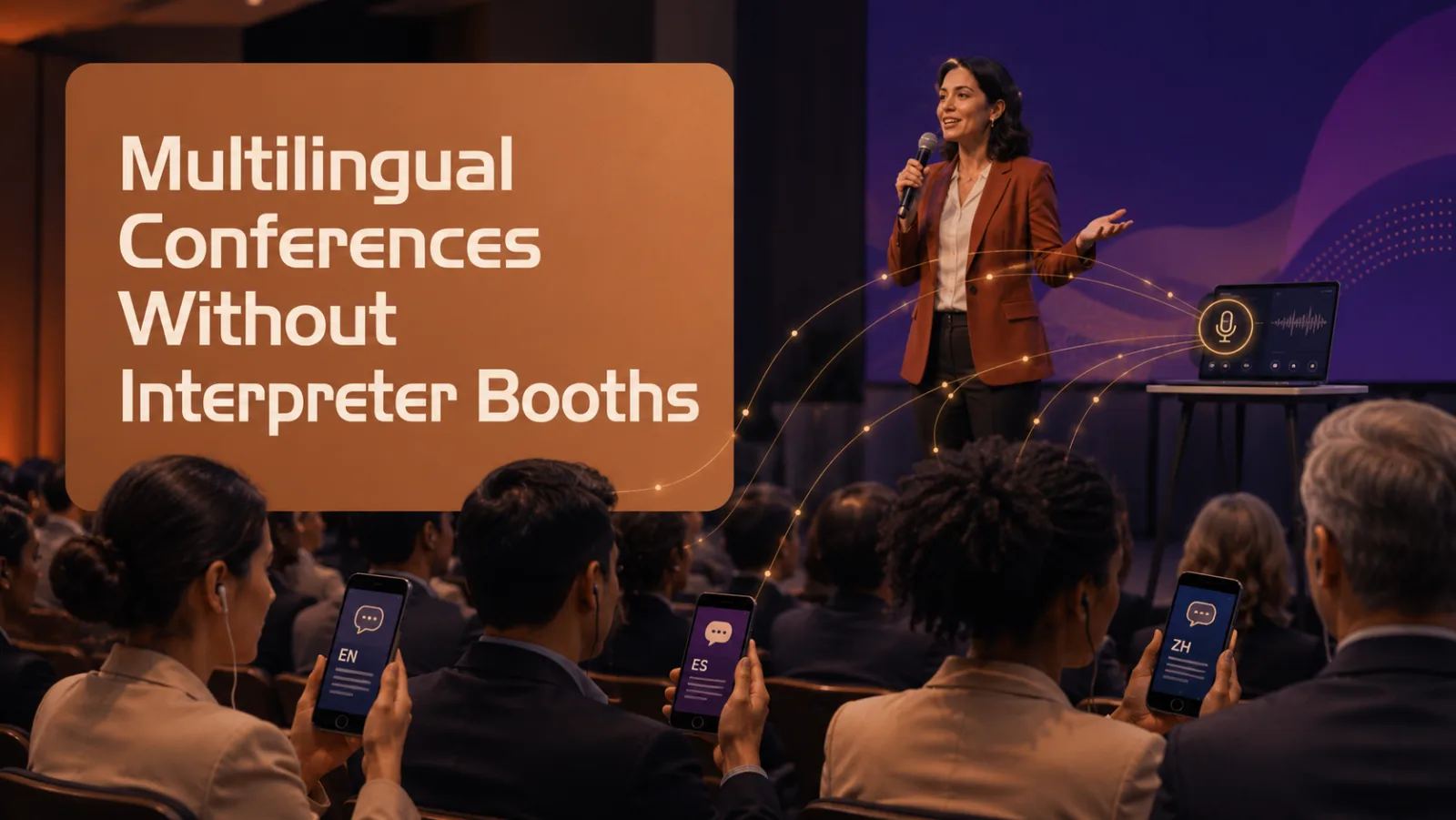
Event Translate is designed for live events that need multilingual access without a traditional receiver-distribution setup. The organiser connects a clean speech feed from the venue mixer to a laptop. Attendees scan a QR code or open a link, choose a language, and listen to translated audio while following a live transcript in their phone browser—no app or attendee account is required.
It can be particularly useful when:
- You want to offer several target languages from the same event
- Attendee numbers may change and you do not want per-listener charges
- The venue has multiple stage microphones
- Speakers use names, acronyms or industry terminology that can be prepared in a custom glossary
- You need a lightweight, repeatable setup for conferences, workshops, lectures or community gatherings
- Cantonese, mixed-language speech or other commonly underserved language patterns are important to your audience
Event Translate currently provides translated audio and live transcripts in 35 output languages, supports multi-microphone event setups and lets listeners join in a browser. It is still an AI system: it requires a stable connection, a clean audio feed and sensible testing, and it does not replace human judgement in high-risk or deeply nuanced communication.
If your conference falls into the structured, lower-risk category, you can use the free trial to test your own speakers, terminology and equipment before making a decision — the plan comparison sets out current limits and included capabilities. If your event contains a mixture of high-risk and lower-risk sessions, consider using professional interpreters where their judgement matters most and Event Translate where broader language access for a conference would otherwise be impractical.
The bottom line
Choose human interpreters when nuance, accountability and the consequences of error are the deciding factors. Choose AI interpretation when you need accessible, scalable language support for clear and relatively low-risk content. Use a hybrid plan when different sessions carry different levels of complexity and risk.
The right question is not “Which option is more advanced?” It is “Which option helps this audience understand this message responsibly?”
Planning a multilingual conference? Try Event Translate free with your own audio and target languages, or contact the team to discuss whether AI interpretation is suitable for your event.
Frequently asked questions
Is AI interpretation accurate enough for conferences?
It can be suitable for clear, structured and lower-risk conference content, but quality varies by language, terminology, audio conditions and platform. Test the system with your real speakers and equipment. For legal, medical, safety-critical or highly sensitive communication, qualified human interpreters are the safer choice.
Is AI interpretation cheaper than human interpretation?
It is often less expensive, especially when an event needs several target languages or serves many attendees. However, providers use different pricing models, and organisers should include any required devices, internet, audio equipment and technical support when comparing the total cost.
Do AI interpretation systems require special equipment?
Requirements vary. Event Translate uses a modern laptop browser, a stable internet connection and a clean speech feed, usually from the venue mixer through a USB audio interface. Attendees join through their phone browsers, so dedicated receivers are not required.
Can AI replace simultaneous interpreters?
AI can replace or extend language provision in some structured, lower-risk sessions, but it cannot fully reproduce a professional interpreter's cultural judgement, ethical responsibility and ability to manage ambiguity. It should not be treated as a universal replacement.
Can a conference use both AI and human interpreters?
Yes. Many events can use human interpreters for high-stakes or highly nuanced sessions and AI for workshops, overflow rooms, captions or additional languages. Plan the attendee journey and technical workflow carefully, because not every platform combines both services directly.